- Promptwatch found that how-to content and documentation together made up 8.2% of the ChatGPT citations it classified in its study period.
- ChatGPT recommended Attio first for an agent-controlled CRM use case after searching Attio’s official documentation and citing its MCP capability.
- A narrow Bun guide appeared fourth in a captured Google search for
create simple HTTP server.
Documentation supports use, discovery, and product selection
By the end of this lesson, you should be able to:- explain the two moments in which documentation creates value;
- describe why a focused documentation page is useful to a search engine or agent;
- separate an observation from the conclusion it can reasonably support;
- connect better documentation to a support or growth outcome;
- recognize the pattern shared by the Promptwatch, Attio, and Bun examples.
How documentation creates value before and after product selection
Most teams recognize the value on the right side of this sequence:
The second outcome is possible because search engines and answer engines need sources. A product
capability that exists only in a sales call, a dashboard label, or an internal explanation is
difficult for an external system to retrieve and verify. A public page gives the capability a stable
URL, a name, an explanation, and evidence.
Promptwatch: how-to and documentation made up 8.2% of classified ChatGPT citations
Promptwatch analyzed 1,027,802 classified ChatGPT citations from 1 January to 4 February 2026. In that sample:- How-To pages accounted for 5.9% of classified citations.
- Documentation pages accounted for 2.3%.
- Together, those two categories accounted for 8.2%, or roughly one in twelve classified citations.
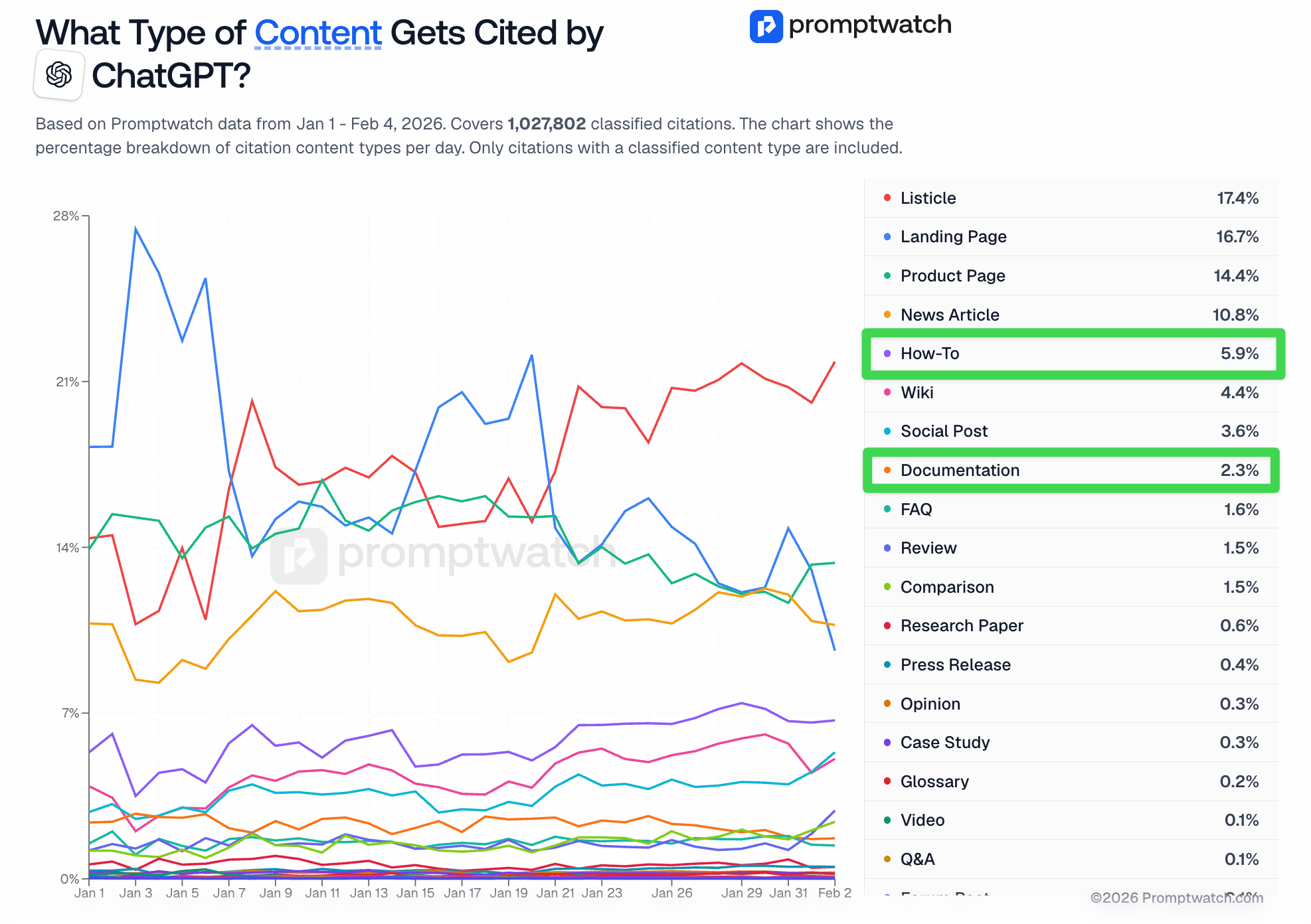
Promptwatch's classified ChatGPT citations included 5.9% How-To content and 2.3% Documentation between 1 January and 4 February 2026.
What the Promptwatch citation data supports
How-to content and documentation form a meaningful part of the material ChatGPT cites. They are not only destinations for people who already know the product name. This makes sense from first principles. Many questions sent to an answer engine are practical:- How do I complete this task?
- Which product supports this workflow?
- What is the correct request or configuration?
- Why did this operation fail?
What the Promptwatch citation data does not prove
The chart does not show that documentation is the largest citation category, that every documentation page will be cited, or that changing a title will cause an 8.2% gain. Promptwatch also notes that its chart includes only citations it classified and that the mix of source types changes over time. Treat the result as evidence that these page types participate in AI discovery, not as a guaranteed ranking formula.Attio: dedicated MCP documentation supported an agent recommendation
The Attio example begins with a broad product-selection question, not a branded search:what crm can i use that an ai agent can control and help me do my crm tasksIn the captured result, ChatGPT considered Attio, HubSpot, Pipedrive, and Salesforce. It recommended Attio first for an AI-agent-centric setup and supported that recommendation with Attio’s official MCP integration, REST API, and webhooks. The result cited Attio’s documentation.
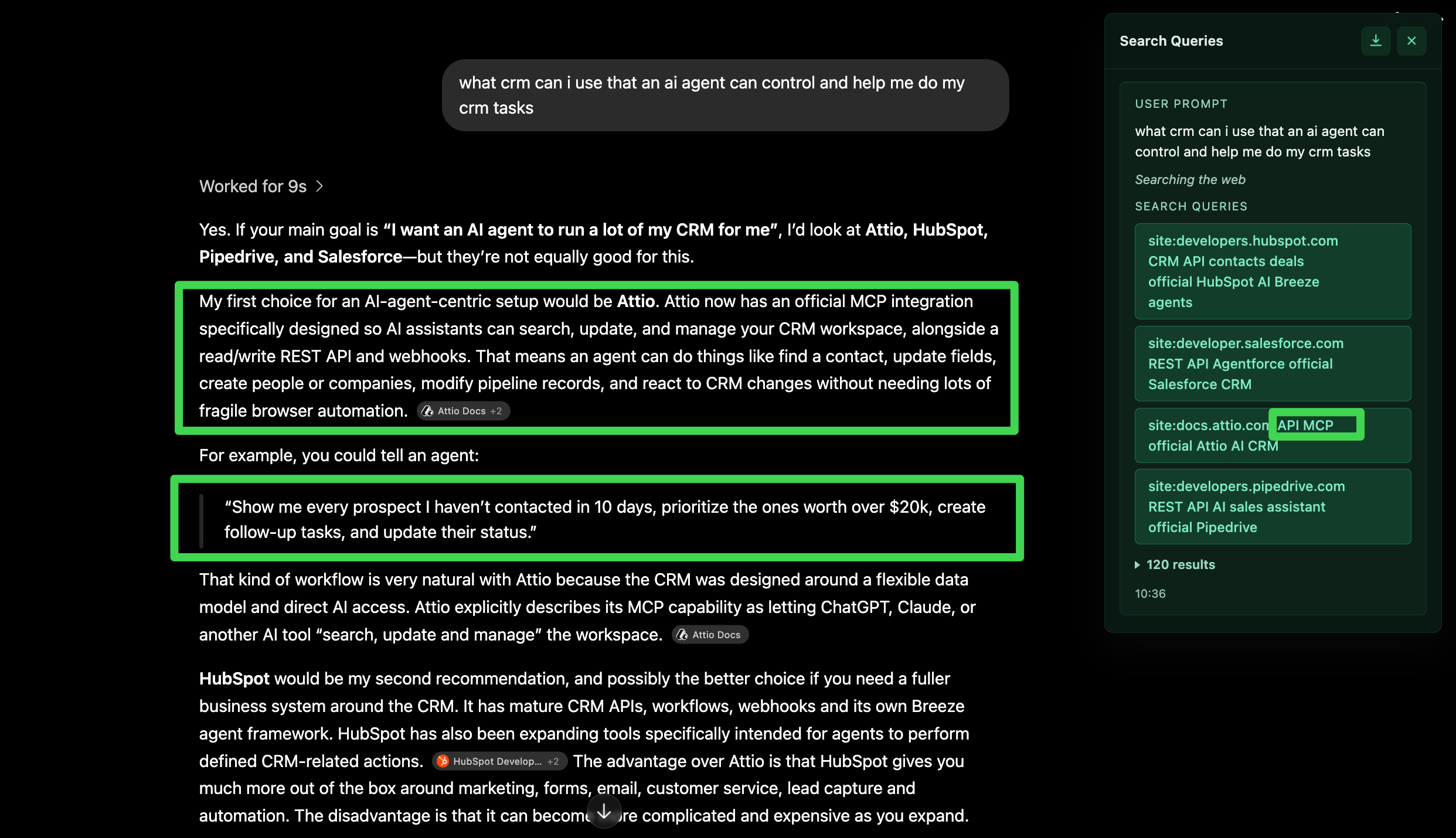
For a generic agent-controlled CRM question, the captured ChatGPT result recommended Attio first and cited Attio Docs as evidence for its MCP capability.
- What is Attio MCP?
- Why would someone use it?
- What can an agent do with it?
- How is it connected?
- Which tools are supported?
- What could a user ask an agent to do?
- What are the rate limits and security conditions?
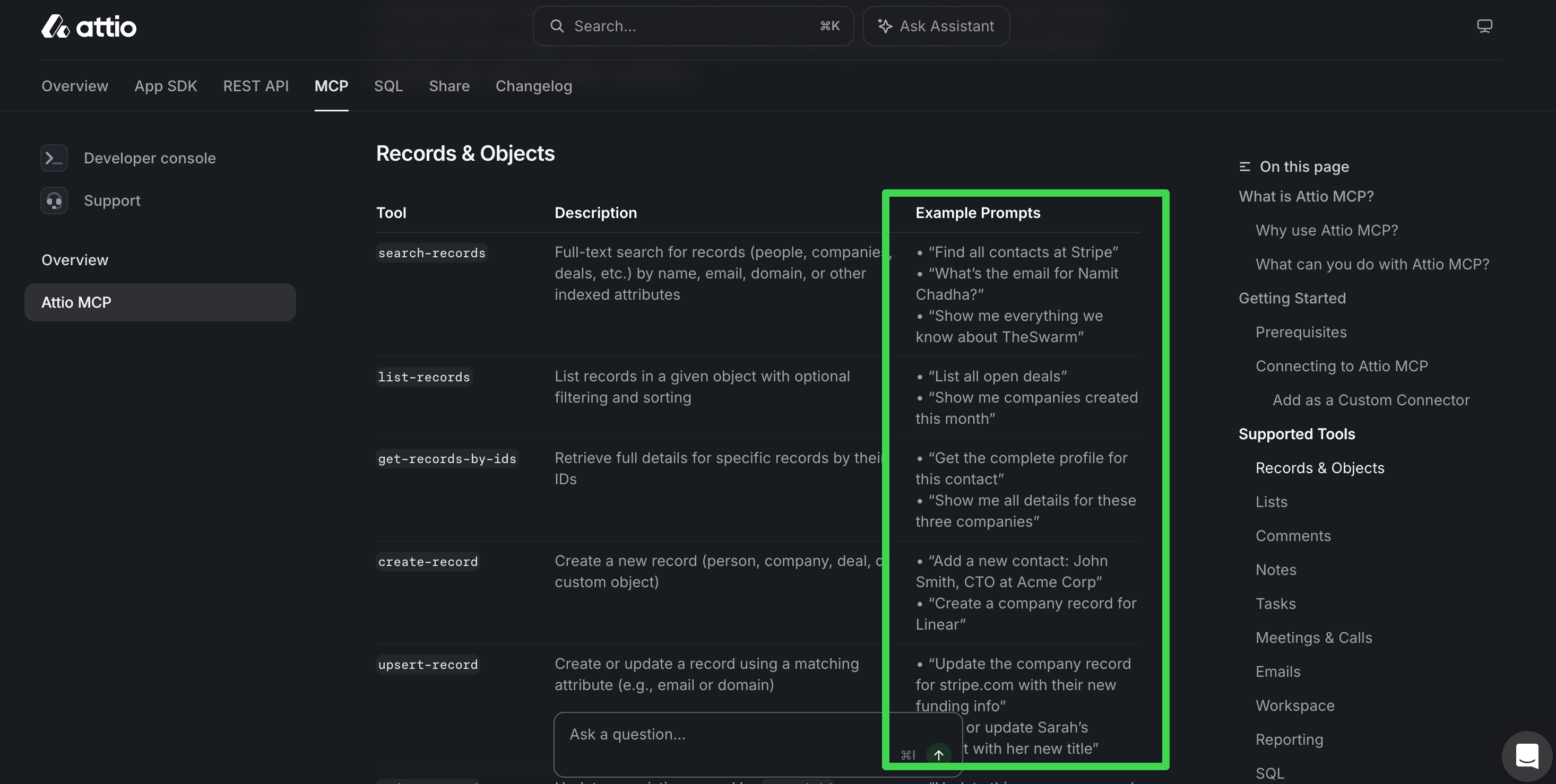
Attio's MCP page maps supported tools to descriptions and example prompts, making the agent capability concrete rather than merely claiming AI support.
Why Attio’s MCP page is useful to an AI agent
An agent cannot reliably recommend a capability it cannot identify. The Attio page turns an abstract claim—“our CRM works with AI agents”—into a source that answers four retrieval questions:
That specificity gives an answer engine something it can use to explain why the product fits the
request. The documentation does more than make Attio mentionable; it makes the recommendation
defensible.
What the Attio recommendation does not prove
This is one captured result. It does not prove that Attio will always be recommended ahead of HubSpot, or that the MCP page was the only cause of the recommendation. Product fit, brand knowledge, other sources, the model, and the wording of the prompt can all change the answer. The defensible lesson is narrower: when the model looked for evidence of an agent-controllable CRM, Attio had a dedicated first-party page that clearly described and demonstrated that capability.Bun: a task-specific documentation page ranked for a generic search
The Bun example shows the same principle in traditional search. In the supplied Google result forcreate simple HTTP server, Bun’s guide ranked fourth with the title
Write a simple HTTP server.
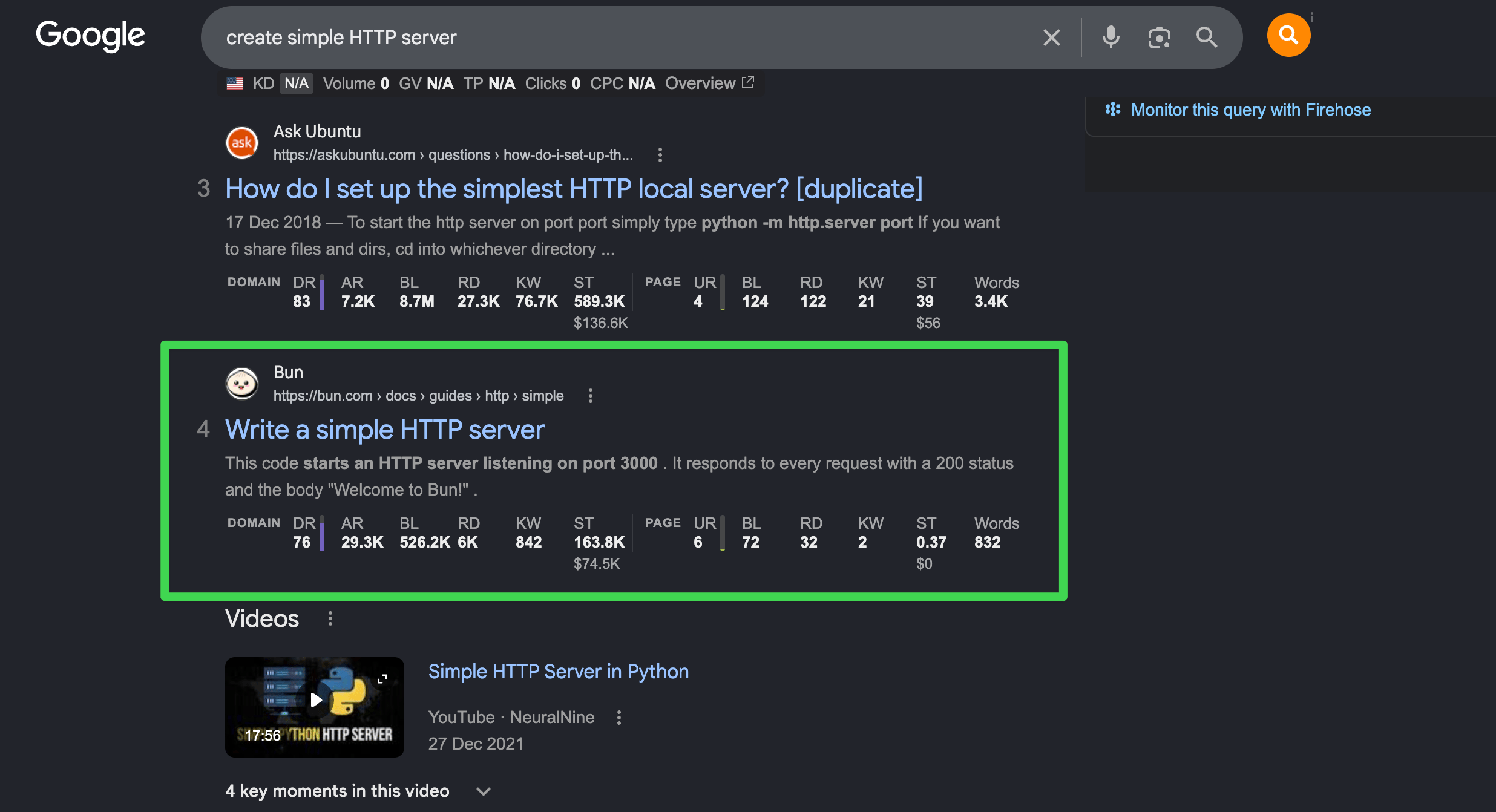
In this captured Google result for create simple HTTP server, Bun's focused guide appeared in position four.
Compare the focused title
Write a simple HTTP server with a broad title such as HTTP or
Bun.serve reference. The focused version tells a searcher, search engine, or agent:
- which task the page owns;
- what outcome to expect;
- why this page differs from neighboring HTTP pages;
- which page to retrieve for this exact question.
What the Bun search result does not prove
A search-result position is a snapshot. It can vary by date, location, device, and search-result changes. The screenshot does not isolate which ranking factor produced position four. What we can observe is that a product documentation page matched a non-branded task query with a narrow title and a page dedicated to the requested outcome.How documentation enters search and agent discovery
The three examples operate at different levels, but they fit one discovery chain:- Find: Can a person, search engine, or agent identify the right page for the question?
- Use: After selecting it, can a person or agent complete or verify the answer?