> ## Documentation Index
> Fetch the complete documentation index at: https://docs.synscribe.com/llms.txt
> Use this file to discover all available pages before exploring further.
# How to extract keywords from competitors doing programmatic SEO
> Turn a small keyword list into a big one by mining the sitemaps of competitors who already win at programmatic SEO, grouping what they target, and building your own coverage.
When a competitor already ranks at scale, their sitemap is a list of the keyword patterns they've
bet on. Ask Pi to work out who's winning at programmatic SEO in your space, crawl their sitemaps,
and pull every pattern they target into grouped files, then reshape those groups into your own
pillar coverage. Pi does the research and crawling with the
[keyword-exploration](/platform/keyword-exploration) skill and lands the output against your
[landing-page pillar](/platform/design-landing-page-pillar). In the walkthrough below, a seed set of
roughly 100 keywords becomes about 200 page groups covering close to 1,500 keywords across two
passes.
> **Use this once you have your base.** It assumes you've already done company research, a Product
> Bible, and a first batch of BOFU keywords, and that you have competitors executing programmatic SEO
> at scale. If you're still finding your first keywords, start at
> [How to find keyword opportunities](/platform/keyword-exploration).
## The idea
Programmatic SEO means one page template stamped across hundreds of near-identical queries: an AI
video tool builds a `text-to-video` page, a `blog-to-video` page, a `youtube-shorts-maker` page, and
so on. A competitor who's been at it for a while has already tested which of those templates earn
traffic. You don't have to guess the map. You can read theirs.
The method has five moves, and Pi runs each one for you:
1. Find who's best at programmatic SEO in your category, and roughly how much traffic each pattern
pulls, so you copy the winners rather than the noise.
2. Read their sitemaps to see the templated page families they run (often a nested sitemap groups
them for you, like a `/make/` or `/platform/` section).
3. Brainstorm the commercial angles first, the use cases where people actually spend money, so the
expansion leans toward buyers rather than high-volume filler.
4. Have Pi crawl each competitor's sitemap and dump the keywords behind their dominant strategy, one
file per competitor, worked in parallel with subagents.
5. Regroup everything into your own pillar categories, dump all observed keywords one file per group,
and flag what's unique to you. The big set then flows into evaluation.
## Steps
Each step below has the real prompt to send Pi, followed by what comes back. Copy the prompt, swap
the `[bracketed]` parts for your own, and follow along.
### 1. Ground the account
Confirm the Product Bible, base keywords, and (ideally) a horizontal landing-page pillar are already
in place, so Pi expands against what you actually sell. See
[the Product Bible](/platform/company-research-product-bible) and
[Design a landing-page pillar](/platform/design-landing-page-pillar). Starting from scratch, this one
prompt builds the base and passes it forward:
```text theme={null}
i'm working on [my product], help me:
1. do a website research
2. build a product bible
3. update my org info
4. do deeper research on what BOFU keywords i need, see the 2d keyword labeling framework
5. expand on the keywords and think about programmatic SEO templates that would be useful
6. (in parallel to 5) using the product bible, help me plan a horizontal landing page pillar (create it)
do in sequence, passing data from prev to the next, use subagents.
```
Pi runs each step in order and hands the base keywords and pillar into the next stage.
### 2. Get a competitor report and the commercial angles
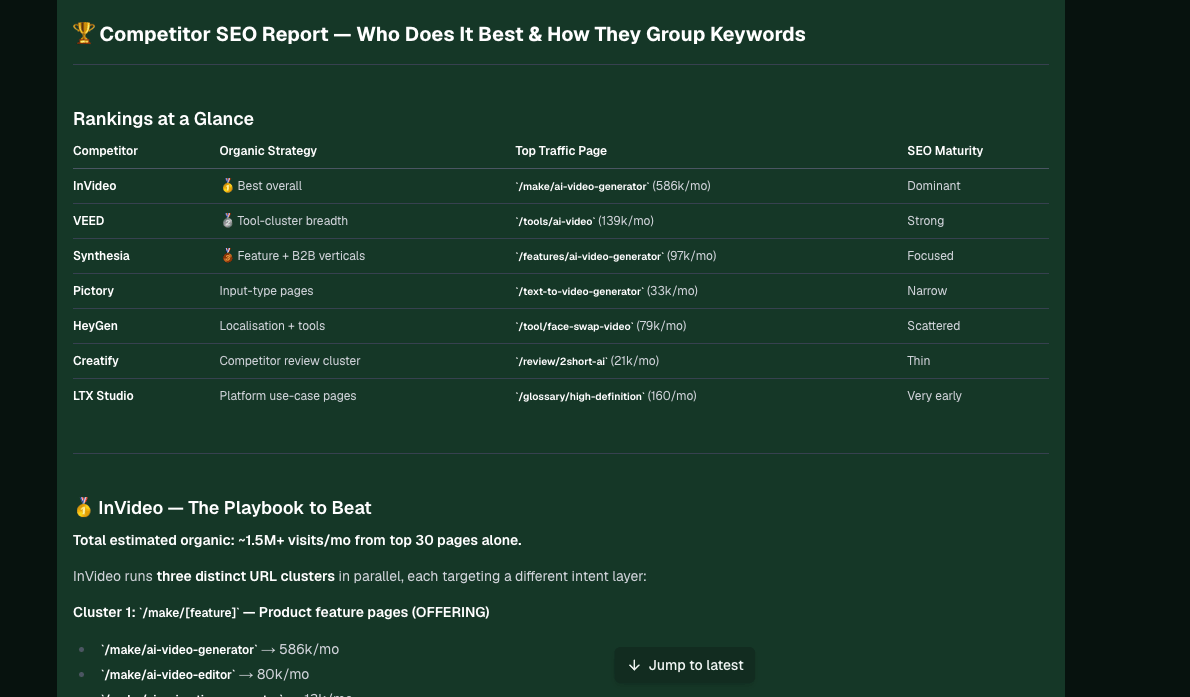
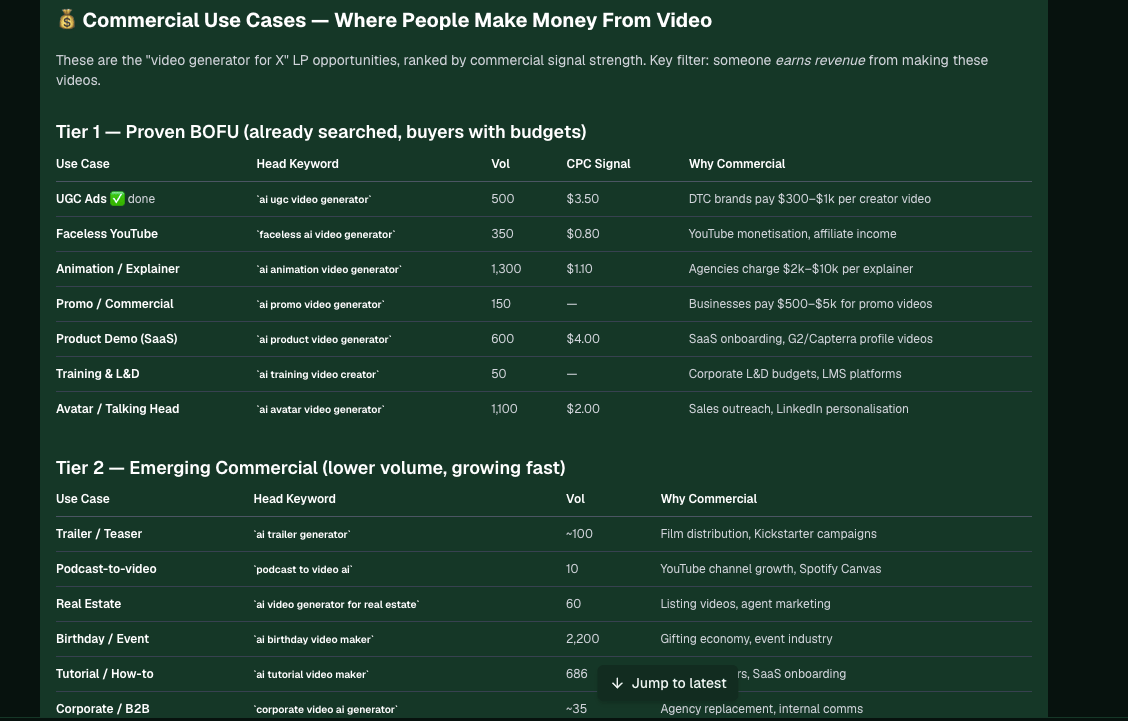
In one pass, ask Pi to brainstorm the commercial use cases (the ones where someone makes money) and
research who ranks best, how mature their SEO is, and how they group their keywords. The report tells
you whose sitemap is worth mining; the use cases keep the expansion pointed at buyers.
```text theme={null}
i want you to brainstorm on more use cases that are more commercial,
ie people who make money from what we sell (ugc ads is one example).
find more use cases in that "[product] for x" shape. research some
other competitors and see how they group and structure their pages,
then give me a full competitor report on who does SEO best and how
they group their keywords.
```
Pi ranks the competitors, maps their strategies, and groups the commercial angles.
 > **Finding the commercial angle (mostly a B2C thing).** For B2C products, the useful question is
> who treats it as work: the people who make money from what you sell are the likeliest to pay for
> it, so lead with their use cases. Focus there first before the casual, hobbyist queries. B2B is
> more straightforward, since almost every buyer already has a budget and a job to get done. Either
> way, expand the keywords tied to helping someone make money or save money first.
### 3. Mine each competitor's sitemap, one file each
Point Pi at each competitor's sitemap and have it pull the keywords behind their dominant strategy,
one file per competitor, worked in parallel with subagents.
```text theme={null}
now go to the sitemap for each of these and pull out their keywords for their dominant
strategy, and tell me what keywords i should target next. use subagents, one file each.
```
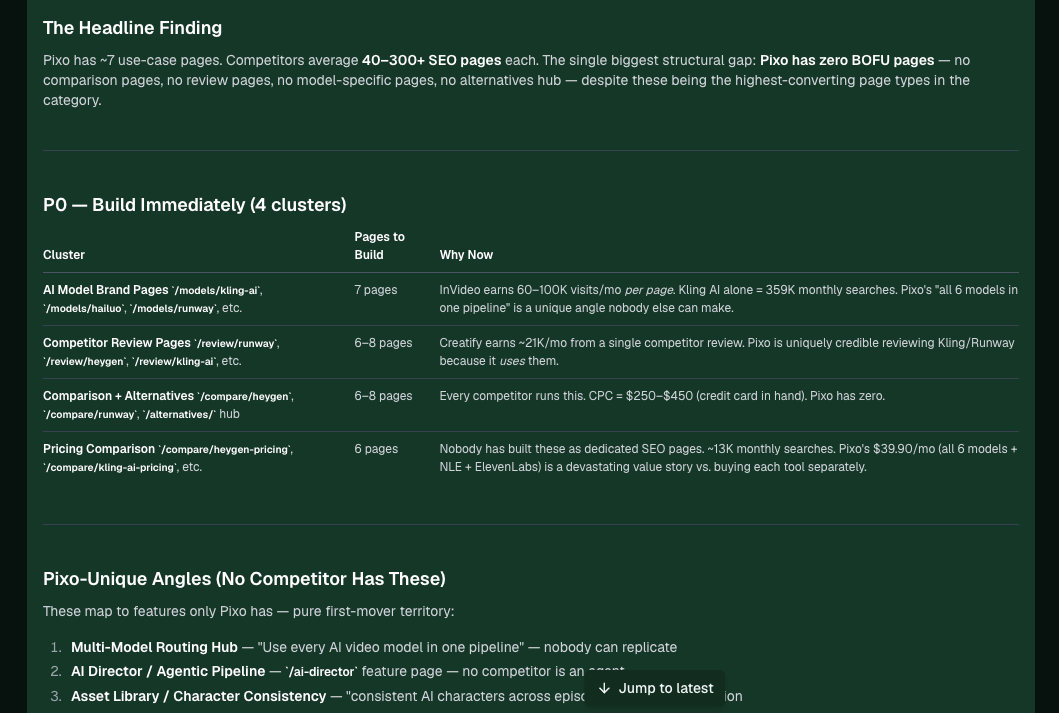
Pi writes a file per competitor with their target keywords, ordered by their dominant strategy, and
flags the biggest structural gaps.
If a long run stalls partway, have it resume and persist to files so nothing is lost:
```text theme={null}
previously you were researching various competitors. continue the task and write it out to
files as you go, so we don't lose the data.
```
> **Finding the commercial angle (mostly a B2C thing).** For B2C products, the useful question is
> who treats it as work: the people who make money from what you sell are the likeliest to pay for
> it, so lead with their use cases. Focus there first before the casual, hobbyist queries. B2B is
> more straightforward, since almost every buyer already has a budget and a job to get done. Either
> way, expand the keywords tied to helping someone make money or save money first.
### 3. Mine each competitor's sitemap, one file each
Point Pi at each competitor's sitemap and have it pull the keywords behind their dominant strategy,
one file per competitor, worked in parallel with subagents.
```text theme={null}
now go to the sitemap for each of these and pull out their keywords for their dominant
strategy, and tell me what keywords i should target next. use subagents, one file each.
```
Pi writes a file per competitor with their target keywords, ordered by their dominant strategy, and
flags the biggest structural gaps.
If a long run stalls partway, have it resume and persist to files so nothing is lost:
```text theme={null}
previously you were researching various competitors. continue the task and write it out to
files as you go, so we don't lose the data.
```
 ### 4. Regroup into your pillar and dump every keyword
Ask Pi to reshape the observed categories into your pillar and dump every keyword it saw, one file
per group, into a folder. Be explicit that you want it comprehensive.
```text theme={null}
these are simply different categories on the pillar. help me:
1. group all these categories so i can put them in the /uses pillar
2. dump ALL keywords observed from competitors, one file per group, be comprehensive,
filed into a new folder.
```
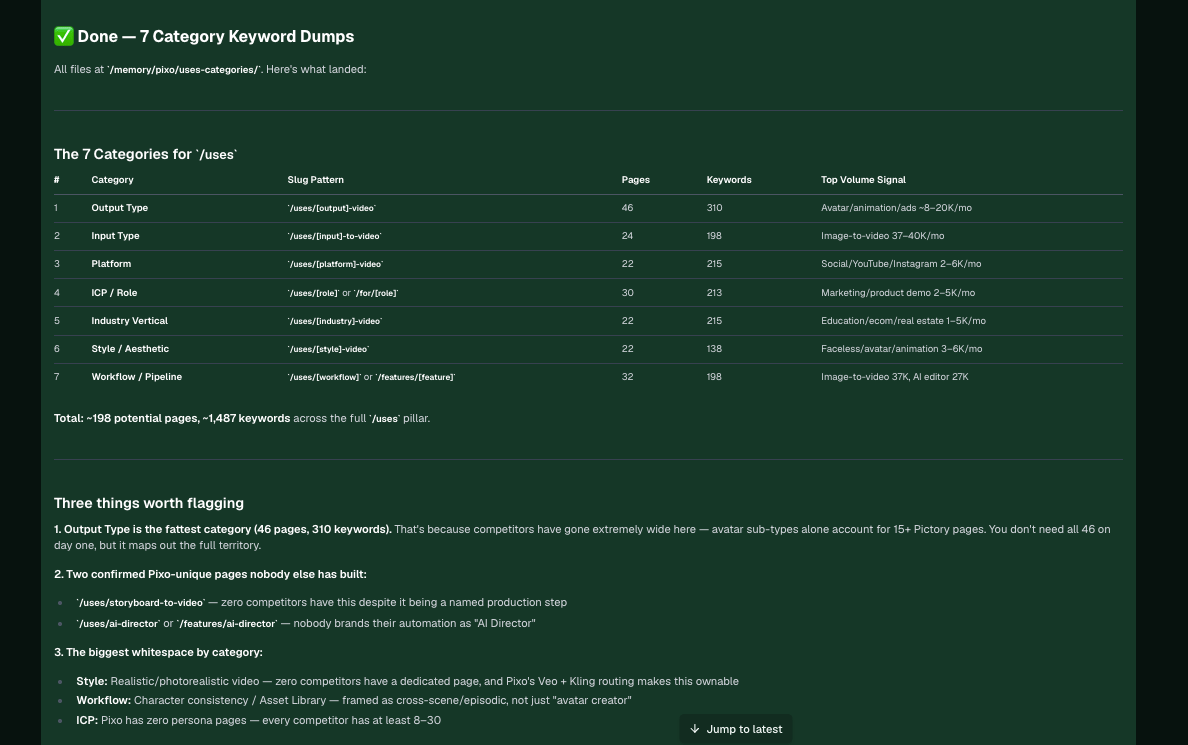
Pi files a folder of grouped keyword dumps plus an overview of which categories are biggest and which
are yours alone.
### 4. Regroup into your pillar and dump every keyword
Ask Pi to reshape the observed categories into your pillar and dump every keyword it saw, one file
per group, into a folder. Be explicit that you want it comprehensive.
```text theme={null}
these are simply different categories on the pillar. help me:
1. group all these categories so i can put them in the /uses pillar
2. dump ALL keywords observed from competitors, one file per group, be comprehensive,
filed into a new folder.
```
Pi files a folder of grouped keyword dumps plus an overview of which categories are biggest and which
are yours alone.
 ### 5. Read the map and the dumps
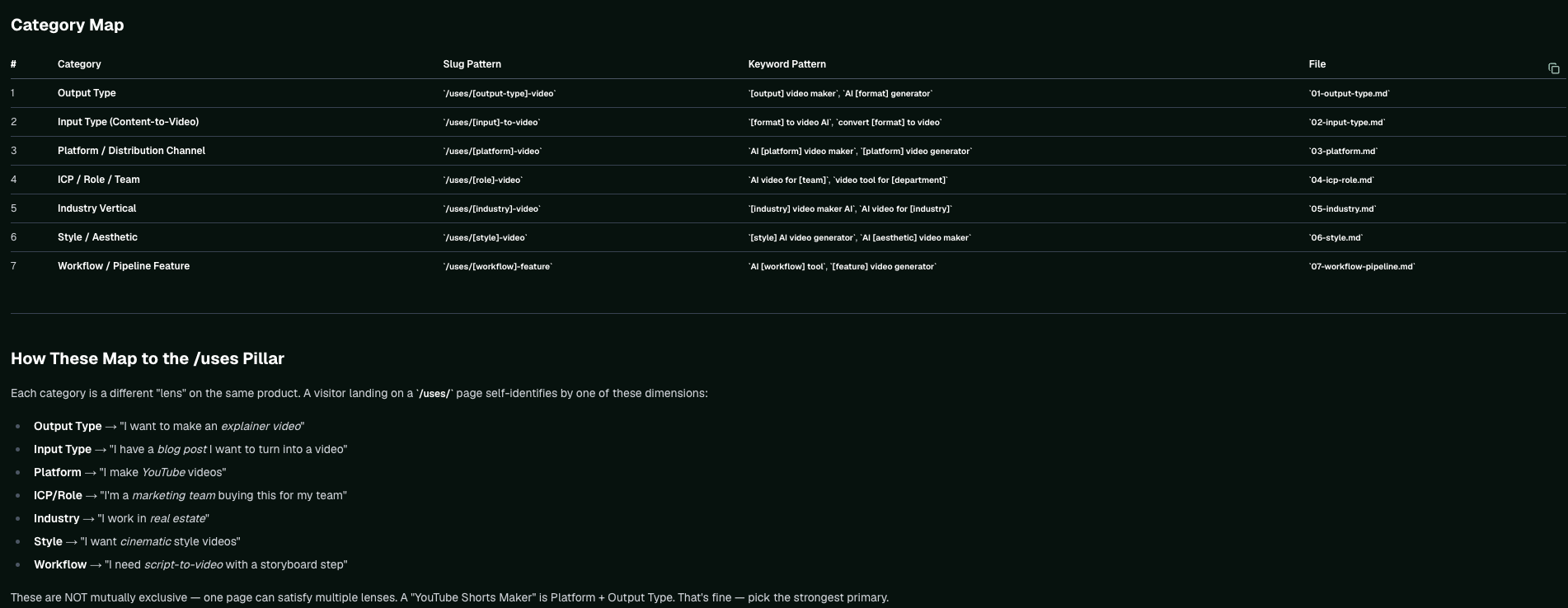
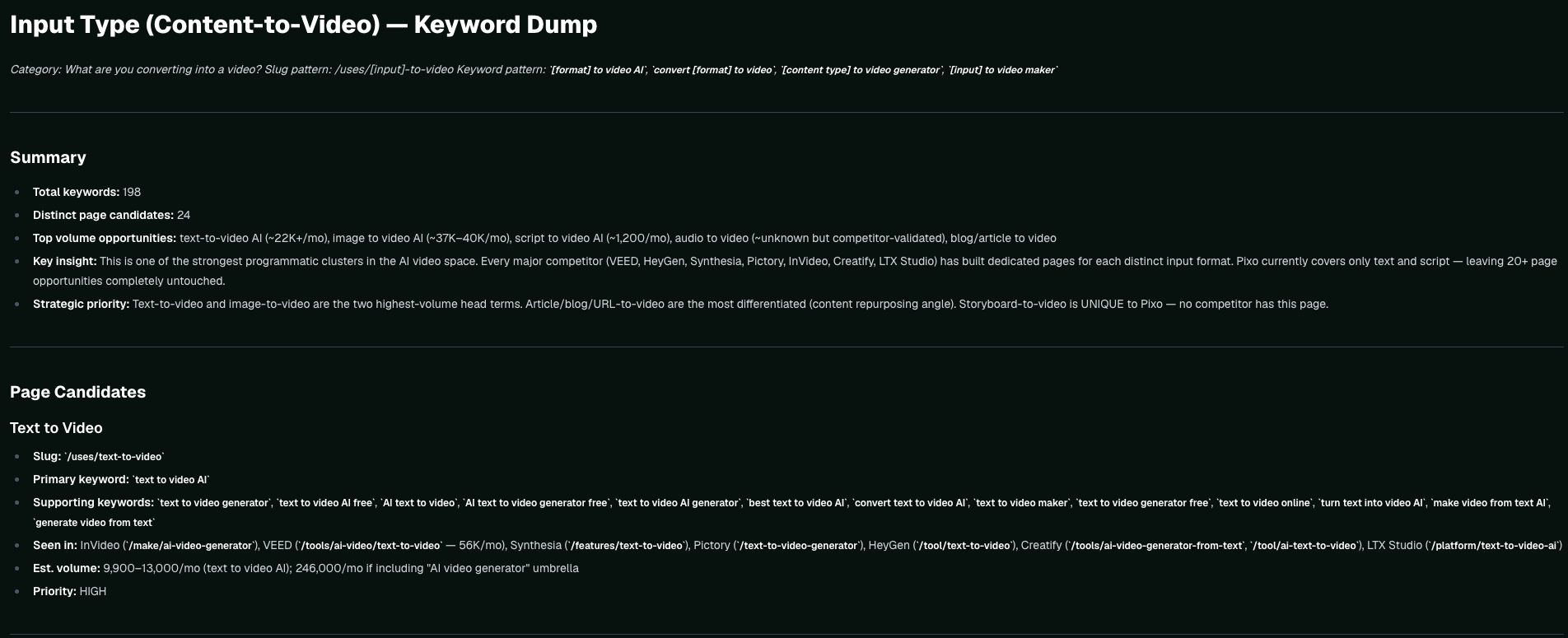
Open the category map to see how each group maps to a slug pattern and a keyword pattern on your
pillar, then open the individual files for the exact target keywords per page.
### 5. Read the map and the dumps
Open the category map to see how each group maps to a slug pattern and a keyword pattern on your
pillar, then open the individual files for the exact target keywords per page.
 ### 6. Prioritise your first-mover pages
Take the flagged unique angles seriously. Pi calls out the pages no competitor has built, which are
your first-mover pillar pages.
***
**Previous:** [How to find keyword opportunities](/platform/keyword-exploration) · **Next:** [How to check if you can rank for a keyword](/platform/evaluate-serp-cliff) · **Theory:** [Horizontal and vertical landing-page pillars](/theory/landing-page-pillars), [BOFU-first](/theory/bofu-first) · **Related:** [Design a landing-page pillar](/platform/design-landing-page-pillar)
### 6. Prioritise your first-mover pages
Take the flagged unique angles seriously. Pi calls out the pages no competitor has built, which are
your first-mover pillar pages.
***
**Previous:** [How to find keyword opportunities](/platform/keyword-exploration) · **Next:** [How to check if you can rank for a keyword](/platform/evaluate-serp-cliff) · **Theory:** [Horizontal and vertical landing-page pillars](/theory/landing-page-pillars), [BOFU-first](/theory/bofu-first) · **Related:** [Design a landing-page pillar](/platform/design-landing-page-pillar)