> ## Documentation Index
> Fetch the complete documentation index at: https://docs.synscribe.com/llms.txt
> Use this file to discover all available pages before exploring further.
# How to set up Pi for your business
> Set Pi up in one short conversation — tell it what you do, and it names itself, learns your account, and seeds the files it reads on every chat.
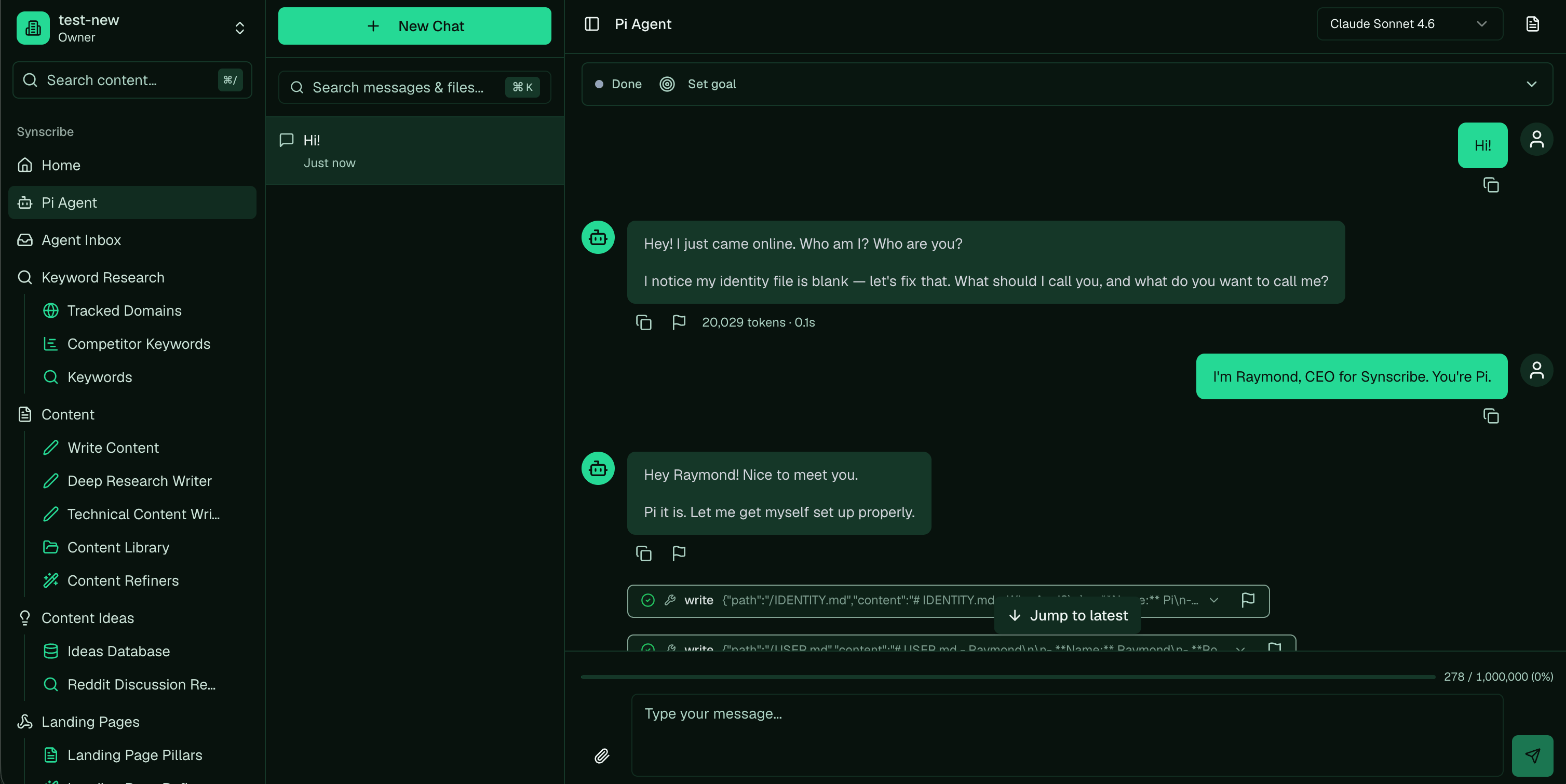
The first time you open Pi, spend a few minutes introducing your business. Tell it what you sell and
who you sell to, hand it a recent sales or planning call, and confirm the name and voice it proposes.
That first pass gives Pi enough to start working, and you can revisit anything it wrote in the
[Files panel](/platform/filing-in-the-vfs) later.
## What to cover in the first conversation
You don't need a script. Talk to Pi the way you'd brief a new hire on your first day together. The
things worth getting across early:
* What your company does, and the product you're trying to grow.
* Who you sell to, and the problem you solve for them.
* Your goals for the next month or two, and any competitors you watch.
* A recent sales or planning call, pasted in, so Pi picks up the specifics in your own words.
A prompt to start with:
```text theme={null}
I'm setting you up for my business. We are [what your company does]. We sell
[product] to [who you sell to], and the main thing we want to grow is [goal].
Give yourself a name and voice, then save the key facts about us to memory.
```
Pi proposes a name and voice, writes them down, and starts its memory of your account. Then hand it
your latest call so it inherits the specifics:
```text theme={null}
[paste your latest sales or planning call] Save this to memory, and pull out the
focus keywords and areas we care about for the first month.
```
 ## The files that shape Pi
As you talk, Pi writes a few core files about your account and reads them back at the start of every
chat. That's how it stays consistent and gets sharper over time.
| File | What it holds |
| ------------- | ------------------------------------------------------------------------- |
| `SOUL.md` | Pi's persona and voice for your account. |
| `IDENTITY.md` | The name and character Pi gives itself for you. |
| `MEMORY.md` | The index of what Pi knows, pointing to the detail files under `memory/`. |
## The files that shape Pi
As you talk, Pi writes a few core files about your account and reads them back at the start of every
chat. That's how it stays consistent and gets sharper over time.
| File | What it holds |
| ------------- | ------------------------------------------------------------------------- |
| `SOUL.md` | Pi's persona and voice for your account. |
| `IDENTITY.md` | The name and character Pi gives itself for you. |
| `MEMORY.md` | The index of what Pi knows, pointing to the detail files under `memory/`. |
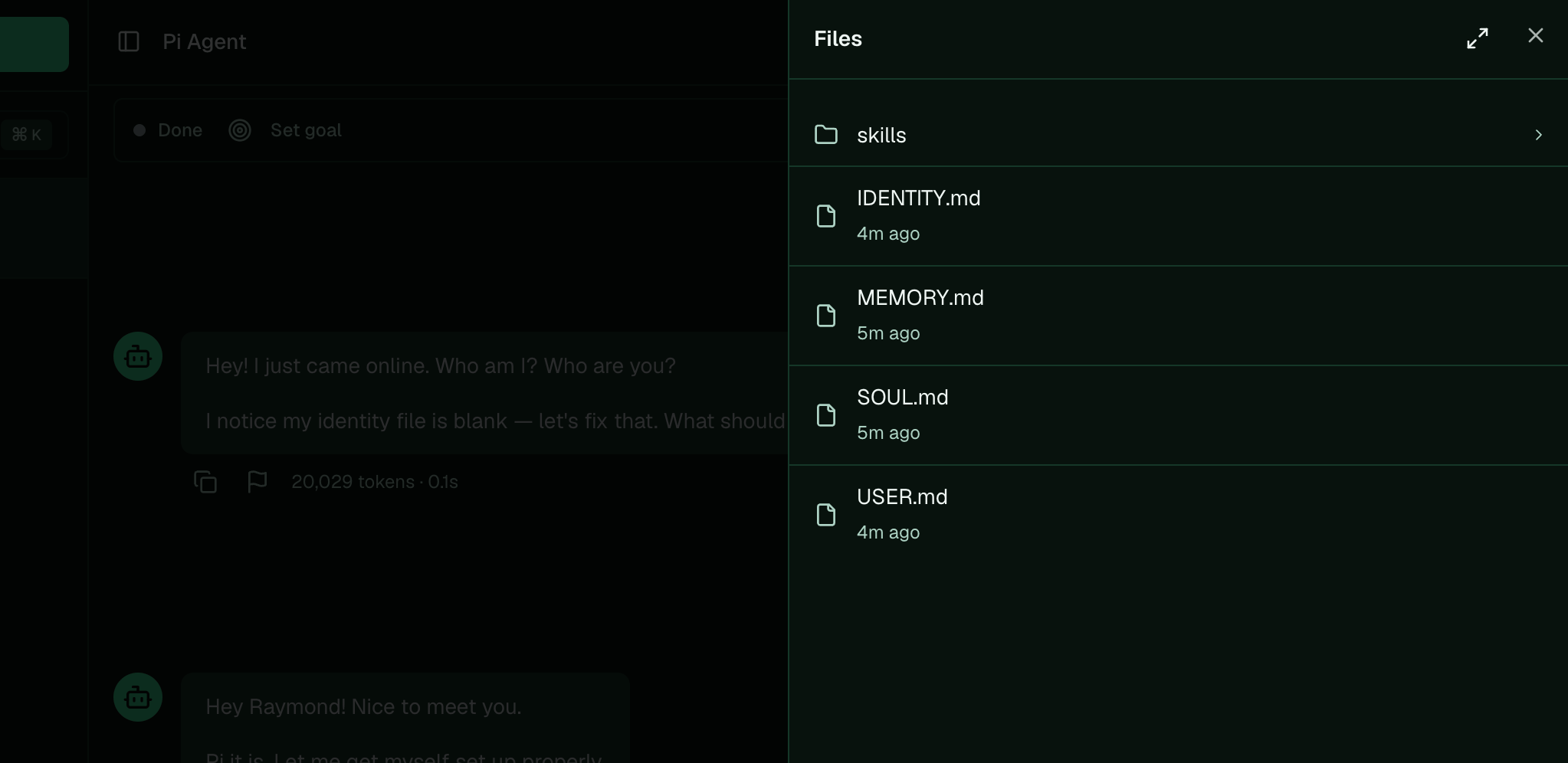 Pi sets these up and refines them as you work, so you rarely touch them by hand. When you want to see
or adjust one, open it in the Files panel. To read more on how memory works and how to save things to
it, see [How Pi works with files](/platform/filing-in-the-vfs).
> 🎬 **Video planned:** the first setup conversation with Pi, naming it and filing your first call to
> memory. See the shot-list.
## For the technically savvy: how these files reach Pi
Skip this unless you're curious about the internals. It doesn't change how you use Pi.
Every turn, Pi rebuilds its own instructions (its system prompt) from scratch. The instructions are
assembled in a fixed order: a hardcoded base (who Pi is and how it works, the same for everyone),
then the tools it can call, then an index of its skills, then **your account's files**, then your
organization's profile. Your files sit near the end, so they layer your specifics on top of the
shared foundation.
The account files are loaded like this:
* `SOUL.md`, `IDENTITY.md`, and `MEMORY.md` are read on every turn and dropped into the prompt (each wrapped in its own labelled block). Editing one takes effect on the next message.
* `MEMORY.md` is injected whole, which is why it's kept as a short index that points to detail files under `memory/` rather than holding everything itself.
* A one-time `BOOTSTRAP.md` runs the very first setup conversation, then deletes itself, so it only shapes Pi while you're getting started.
* Empty files are skipped, so a file only affects Pi once it has content.
Two things worth knowing. Pi's core stance and values are baked into that hardcoded base, not into
`SOUL.md`, so editing `SOUL.md` adjusts tone on top of a foundation you can't remove. And Pi may keep
a small `USER.md` with notes about you (like your name or timezone); today that file is for its own
reference and isn't part of the instructions it loads.
**Next:** [Research your company and build the Product Bible](/platform/company-research-product-bible) · **Related:** [The thesis](/theory/thesis)
Pi sets these up and refines them as you work, so you rarely touch them by hand. When you want to see
or adjust one, open it in the Files panel. To read more on how memory works and how to save things to
it, see [How Pi works with files](/platform/filing-in-the-vfs).
> 🎬 **Video planned:** the first setup conversation with Pi, naming it and filing your first call to
> memory. See the shot-list.
## For the technically savvy: how these files reach Pi
Skip this unless you're curious about the internals. It doesn't change how you use Pi.
Every turn, Pi rebuilds its own instructions (its system prompt) from scratch. The instructions are
assembled in a fixed order: a hardcoded base (who Pi is and how it works, the same for everyone),
then the tools it can call, then an index of its skills, then **your account's files**, then your
organization's profile. Your files sit near the end, so they layer your specifics on top of the
shared foundation.
The account files are loaded like this:
* `SOUL.md`, `IDENTITY.md`, and `MEMORY.md` are read on every turn and dropped into the prompt (each wrapped in its own labelled block). Editing one takes effect on the next message.
* `MEMORY.md` is injected whole, which is why it's kept as a short index that points to detail files under `memory/` rather than holding everything itself.
* A one-time `BOOTSTRAP.md` runs the very first setup conversation, then deletes itself, so it only shapes Pi while you're getting started.
* Empty files are skipped, so a file only affects Pi once it has content.
Two things worth knowing. Pi's core stance and values are baked into that hardcoded base, not into
`SOUL.md`, so editing `SOUL.md` adjusts tone on top of a foundation you can't remove. And Pi may keep
a small `USER.md` with notes about you (like your name or timezone); today that file is for its own
reference and isn't part of the instructions it loads.
**Next:** [Research your company and build the Product Bible](/platform/company-research-product-bible) · **Related:** [The thesis](/theory/thesis)